
So you want to get rich by buying real estate? A lot of individuals try to follow trends or guess when the stock market will go up or down. But serious investors focus on assets that give them stable, dependable income. That’s why real estate portfolios are still one of the best ways to make money over the long run.
If you know the basics of underwriting, have a good market strategy, and use financing instruments that work for investors, such as DSCR and asset-based loans, even one rental can be the start of something much bigger.
In this guide, we’ll show you the exact steps to build a real estate portfolio that produces cash flow, grows your equity, and scales over time without overwhelming you.
What Exactly Is a Real Estate Investment Portfolio?
Your real estate investment portfolio is like a group of assets that make you money and help you build your wealth. It’s about buying several properties that work well together, lower your risk, and provide you with the best returns.
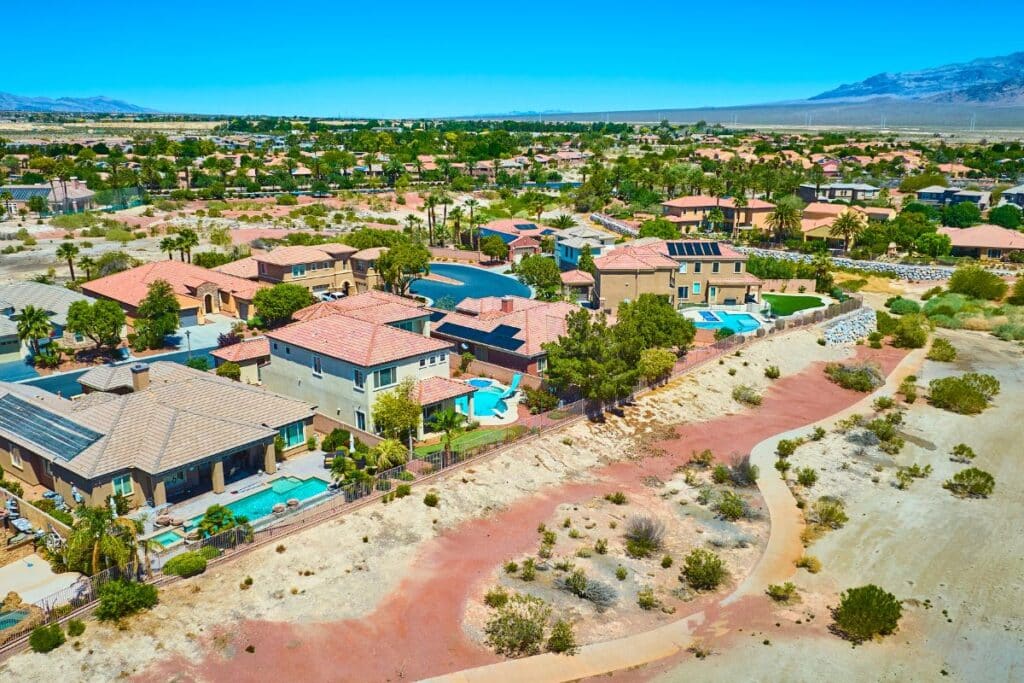
You might have a combination of single-family houses in Henderson, condos near the Strip, and maybe even a modest multifamily property in North Las Vegas in your rental property portfolio. The most important thing is to spread your investments out and not put all your eggs in one basket.
Why Las Vegas Is Perfect for Building Your Property Portfolio
Las Vegas is going through some interesting market changes right now that give investors actual chances to make money. As of November 2025, there were 7,850 active single-family home listings, down from 8,100. The months of available inventory are at 4.8 months, which means the market is balanced but showing indications of softening.
What does this mean for you? It means a chance. Home prices are still very high because there isn’t much new building and more than 75,000 new people move to the area every year. Also, Nevada doesn’t have a state income tax, so you get to keep more of your rental revenue than investors in states with high taxes, like California.
The Las Vegas market offers something for every investor:
- Entry-level properties starting around $300,000
- Strong rental demand from 40+ million annual visitors
- Cash-on-cash returns ranging from 6-12%
- Annual appreciation averaging 6-8%
1. Set Your Goal: Why Build a Real Estate Portfolio?
Write down what you want to do before you buy anything. Are you looking for monthly cash flow, long-term growth, tax benefits, or a mix of these? What you buy and where you buy it will depend on your answer.
- If you want a steady income, look for neighborhoods with low vacancy rates and high demand for rent.
- Value-add properties (rehab and rent) or neighborhoods that are growing quickly are good options if you want to make money faster.
- If you want to spread your money around, you could combine single-family rentals, modest multifamily homes, and maybe REITs later.
Clarity here avoids expensive “strategy drift” down the line.
2. Learn the Basics of Property Selection
A simple checklist that will save you time:
- The health of the market is based on jobs, population growth, rent patterns, and the number of months of inventory. (It’s much more important to look at local market cycles than national averages.)
- Things that matter in a neighborhood include the quality of schools, public transportation, crime rates, and plans for additional construction.
- Cash flow math: anticipated rent minus mortgage, taxes, insurance, maintenance, vacancy, and management fees. Always put numbers through a stress test with a 5–10% vacancy rate and a higher interest rate.
- Exit options: Who will acquire the property in five to ten years? Are the buyers owner-occupants, investors, or institutions? That has an effect on liquidity and the price at which you can sell it.
The 1% approach (monthly rent = 1% of acquisition cost) can be a quick way to narrow down your options, but don’t take it as gospel because local markets are different. At least 1% of the total purchase price should be your monthly rental revenue. You would like to get $4,000 in rent every month for a $400,000 property.
In Las Vegas right now, it could be hard to achieve the entire 1% in high-end locations like Summerlin, but you can get close in up-and-coming communities. When you think about how much the property will go up in value and how much you can save on taxes, a property that makes 0.8–0.9% can still be a good investment.
3. Financing Strategies to Accelerate Growth
How you finance properties determines how fast you can scale.
- Traditional mortgages are good for homes that are lived in by the owner and have lower rates, but they use the borrower’s income to decide if they can get a loan.
- When you get a DSCR loan (Debt Service Coverage Ratio), the lender looks at the rental revenue of the property, not the borrower’s wage. You can qualify for this with just rent, which makes it a great tool for growing a real estate investment portfolio. (Many investors use DSCR to buy single-family rentals with a 20% down payment and then refinance later.)
- HELOC or cash-out refinance: Use the equity in your rental properties to pay for the down payments on your next purchases.
- Hard-money or bridge loans are good for flips or rehabs, but they cost a lot. You should plan to refinance them into long-term debt.
- Partnerships and private money—bring in cash partners to speed up the process of buying.
A disciplined leverage plan with a low LTV and reasonable stress tests is what keeps investors from going too far.
4. Build a Repeatable Acquisition System
Treat portfolio-building like a business:
- Deal sourcing — find one or two lead channels (MLS + local wholesalers, off-market lists, auctions).
- An underwriting template is a simple spreadsheet that shows the purchase price, rehab costs, rents, expenses, financing terms, and cash-on-cash return. If the model doesn’t fulfill your minimum requirements, don’t buy it.
- Team — agent, lender, contractor, property manager, CPA. Scale only after the team is proven.
- Process — make offers quickly on deals that fit your criteria; move on fast when they don’t.
Repeatability beats perfection. The first few deals teach you the most.
5. Property & Portfolio Management (Real Estate Portfolio Management)
Owning multiple properties changes the job from landlord to portfolio operator.
- Operational systems: one accounting system, standardized leases, preventive maintenance schedule.
- Outsource smart: good property managers cost 6–10% of rent, but free your time and reduce vacancies.
- Performance tracking: track NOI, cap rate, occupancy, repairs-per-unit, and cash-on-cash returns quarterly.
- Rebalance: sell underperformers and redeploy into better opportunities.
Think about how big things are. The one property that needed 10 hours of work a week should only need 2 hours of work a week once the procedures are in place.
6. A Sample Growth Path (Practical Roadmap)
A repeatable 4–6 year model many investors use:
- Buy first single-family rental with 20% down — learn property management.
- Refinance or save equity for the second purchase (or use DSCR financed by rent).
- After 3–4 properties, consider an entity structure (LLC) and professional management.
- Use cash-out refinance every 4–6 years if appreciation and pay-down permit to fund down payments for new buys.
Local markets are important because in some places, you can grow faster. After all, the rent-to-price ratio is better. For instance, several neighborhoods in Las Vegas still draw investors looking for cash-on-cash returns of 6–12%, but always check your local numbers first.
7. Risk Management & Common Mistakes
Don’t be the investor who learns the hard way. Common traps:
- Over-leveraging during a rate spike.
- Underestimating capex and vacancy.
- Treating flips like buy-and-hold without a contingency plan.
- Neglecting tenant screening and lease enforcement.
Mitigation: conservative underwriting, 6–12 months of reserves, and an exit plan for each property.
The Las Vegas Advantage
- No state income tax: Keep 100% of your rental income and capital gains
- Tourism economy: 40+ million annual visitors create massive short-term rental demand
- Population growth: 75,000+ new residents yearly need places to live
- Diverse economy: Beyond tourism, growing tech, healthcare, and professional sectors
- Strong rental yields: 6-12% cash-on-cash returns across property types
With 7,850 units in stock and 4.8 months of supply, the current market circumstances are balanced, meaning that neither buyers nor sellers have too much power. This is actually great for investors who know how to negotiate and respond quickly.
Common Mistakes to Avoid
Overleveraging: Don’t try to buy too many houses too quickly. Keep enough cash on hand for maintenance and empty units.
Ignoring cash flow: Appreciation is nice, but having negative cash flow every month can wear you out. After all costs, you should make at least $200 to $300 for each door.
Skipping due diligence: Always hire professionals to check things out, carefully compare prices, and make sure you know the real rental rates in the area.
Neglecting maintenance: Deferred maintenance compounds. Budget 1% of the property value annually for upkeep.
Your Next Step Toward Building Your Real Estate Portfolio
Real estate is a slow, steady way to develop wealth, and the investors who win are the ones who handle it like a business. The most important thing is to make one smart buy and then let the momentum work for you.
A&P Lending Titans can help you figure out how much money you can spend, look into DSCR and investor-friendly loans, and pick the best plan for your needs if you’re ready to take the initial step. Call us at 702-277-4994 or come to 8495 W Sunset Rd Ste. 102, Las Vegas, NV 89113. Let’s construct your real estate investment future, one property at a time.
Frequently Asked Questions
Q: How much money do I need to start building a real estate portfolio?
A: For investment properties in Las Vegas, plan on a 20-25% down payment plus 6-12 months of reserves. On a $400,000 property, that's roughly $80,000-100,000 down payment plus $20,000-30,000 reserves. However, DSCR loans and creative financing can reduce these requirements.
Q: What's the best property type for beginners building a rental property portfolio?
A: Single-family homes are typically best for beginners due to simpler management, easier financing, and broader appeal to tenants. In Las Vegas, properties in the $300K-450 range in North Las Vegas or East Las Vegas offer manageable entry points with solid rental demand.
Q: How many properties do I need in my real estate investment portfolio?
A: There's no magic number, but most investors aim for 5-10 properties generating $500+ monthly cash flow each. That creates $2,500-5,000 monthly passive income. Your goal should align with your financial objectives – whether that's replacing your job income, funding retirement, or building generational wealth.
Q: How to build a property portfolio in a competitive market like Las Vegas?
A: Focus on emerging neighborhoods before they peak, consider off-market deals through networking, use DSCR loans for faster acquisitions, and act decisively when good deals appear. November 2025 shows a balanced market with 4.8 months of inventory – perfect for strategic buyers who aren't in bidding wars.
Q: What returns should I expect from my real estate portfolio?
A: In Las Vegas, realistic expectations include 6-12% cash-on-cash returns, 6-8% annual appreciation, and total returns of 12-20% when combining cash flow, appreciation, equity buildup, and tax benefits. Properties in different neighborhoods and types will vary, which is why diversification matters.